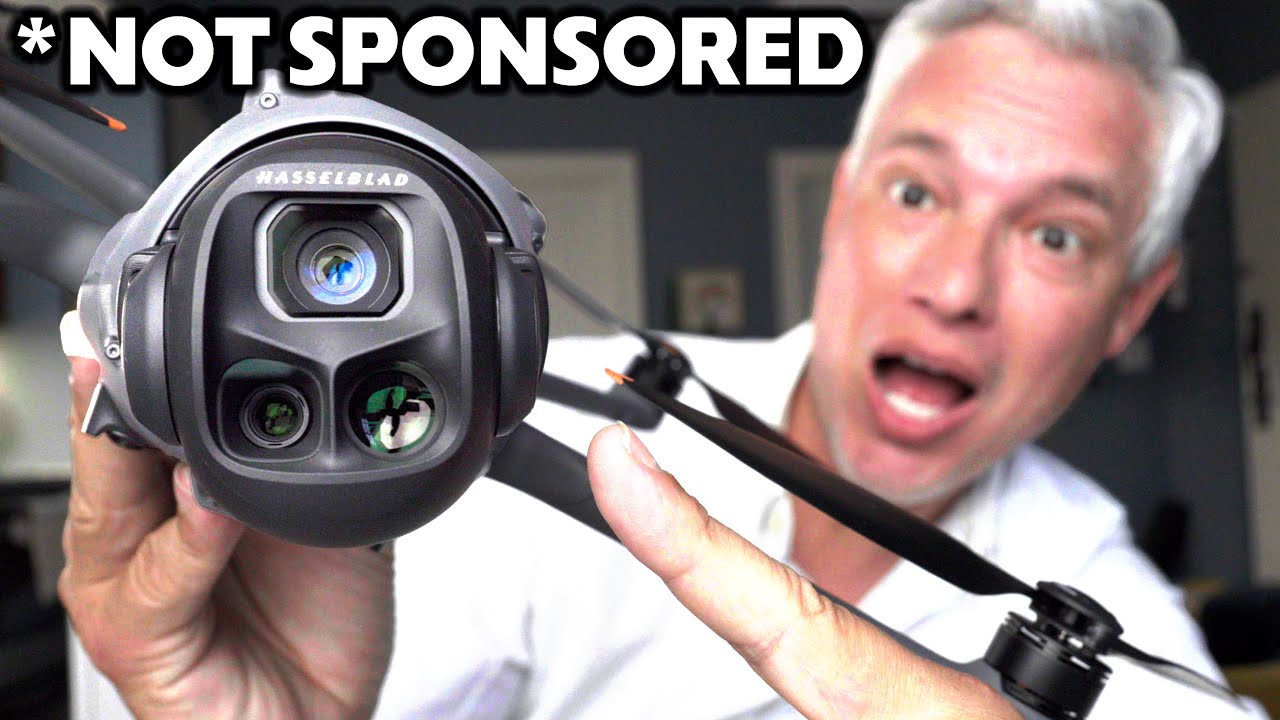
Regardez ce long-métrage sur «drone» directement en streaming sur Youtube.
À travers ce contenu, Tony & Chelsea Northrup s’intéresse à « drone ».
Une création de Tony & Chelsea Northrup à voir sur youtube.
se concentrant sur « drone »:
Nous avons constaté un fort engagement autour de cette vidéo lors de notre récente découverte. Le compteur de Likes indiquait: 2031.
La vidéo d’une durée de 00:09:39 secondes, intitulée The TRUTH about the Mavic 4 Pro drone, créée par [vid_author_name], est accompagnée de la description suivante :« Achetez le Mavic 4 Pro sur http://sdp.io/m4p (si vous pouvez), achetez le Mavic 4 Pro à http://sdp.io/m3p Tony Northrup passe en revue le Mavic 4 Pro et le compare au Mavic 3 Pro pour la vidéo et la photographie immobile en utilisant les trois lentilles. Tony découvre également quelques problèmes graves, notamment le fait que la vidéo verticale est impossible à compter et que la vitesse n’est que 3% meilleure que le Mavic 3 Pro lors du vol au vent. Tony compare également l’appareil photo 100 mégapixels aux autres 100 mégapixels Hasselblad, le CFV et le 100c … avec des résultats choquants! 0:00 Introduction 0:44 Life de la batterie: Mavic 3 Pro vs Mavic 4 Pro 0:57 Speed: Mavic 3 Pro vs Mavic 4 Pro 1:50 Stabilité: Mavic 3 Pro vs Mavic 4 Pro 2:56 VIDEO VIDEO 8:47 Qualité d’image à faible luminosité 8:57 Résumé ».
Avec son immense catalogue de vidéos, youtube donne aux utilisateurs la possibilité d’explorer des contenus originaux et enrichissants tout en respectant leur confidentialité.
Des Solutions Aériennes : Une Entreprise de Drone Professionnelle
Les drones professionnels ont apporté une véritable révolution dans plusieurs industries en France. Que ces dispositifs soient employés pour la surveillance des cultures, l’inspection de ponts ou la cartographie des ressources naturelles, ils offrent des vues inédites avec une précision et une efficacité optimisées. Dans le monde actuel, faire appel à une entreprise de drone est devenu une solution clé pour satisfaire les besoins des particuliers, des collectivités et des entreprises.
Avec les nouvelles technologies, un drone professionnel peut réaliser des missions variées tout en garantissant une grande précision. Cet équipement est utilisé pour l’inspection de bâtiments, la surveillance de chantiers, la cartographie de terrains et la réalisation de films et productions audiovisuelles. Pour garantir un travail de qualité, faire appel à des pilotes formés et certifiés par la DGAC est essentiel.
Un drone offre la possibilité de réaliser des inspections techniques en toute sécurité. Il est utilisé pour examiner l’état des infrastructures, pour identifier d’éventuels défauts et pour améliorer la gestion des risques. Les images aériennes fournissent des vidéos et photos en haute définition, qui conviennent parfaitement aux projets de communication, au tournage de films ou aux suivis de chantiers. La cartographie et la modélisation rendent possible la reconstitution de structures en 3D et la réalisation de relevés topographiques précis.
Obtenir une certification de la DGAC est indispensable pour travailler en tant que pilote de drone professionnel. La formation aborde la maîtrise des réglementations, le respect des protocoles de sécurité et la gestion des vols en zones spécifiques. Ces savoir-faire permettent de réaliser des missions en toute conformité légale et de satisfaire les demandes des clients.
En tant que prestataire français, SupraDrone se spécialise dans les services de drone professionnel. Il est implanté dans plusieurs départements et régions de France et gère l’ensemble des démarches administratives concernant les vols de drones. En collaboration avec la DGAC, les services des préfectures et les mairies, les autorisations sont gérées par SupraDrone et la conformité réglementaire est assurée avant chaque mission.
Une fois les démarches complétées, SupraDrone fait appel à ses opérateurs de drone locaux pour fournir des services personnalisés selon les attentes des clients. Que ce soit pour une production audiovisuelle, une inspection technique ou une mission de cartographie, chaque projet est confié à un pilote qualifié. Grâce à cette structure, l’entreprise s’assure d’une intervention rapide et efficace, tout en proposant un accompagnement personnalisé dans chaque région. En fusionnant expertise technique et administration optimisée, SupraDrone s’affirme comme un acteur incontournable du secteur du drone professionnel en France.
En tant que prestataire de drone professionnel, SupraDrone a centralisé la gestion des déclarations et formalités administratives à Paris, près de la DGAC. Son réseau de télépilotes répartis en régions permet des interventions rapides sous 24 heures. Nos services
Ce lien vous permet de voir la vidéo sur youtube :
la publication originale: Cliquer ici
#TRUTH #Mavic #Pro #drone
Retranscription des paroles de la vidéo: I’m not supposed to have the Mavic 4 Pro. You see, DJI decided not to ship it to America at all, probably because of the tariff confusion. So, I just decided to pre-order it from Adorama. And I was like one of the few people to actually be able to buy it. So, this is one of the first American reviews you can see where the person paid for it with their own money and thus isn’t holding the DJI at all. So, I’m going to give you a really unbiased review. I’m going to tell you how it compares to the old Mavic 3 Pro that’s been our trusty drone up until now, the best drone in the world. And I’m going to tell you how the 100 megapixel Hasselblad camera compares to this 100 megapixel Hasselblad camera. First, let’s talk about how they fly. The battery life on both is really good, but the Mavic 4 Pro has a little bit better battery life. real world, I found myself only getting a couple more minutes of flight time, but sometimes a couple more is all you need. The Mavic 4 is significantly faster, at least in the specs. Heading downwind on a windy day, I found it was about 12% faster than the Mavic 3 Pro, but both are definitely artificially limited. Like, they both hit a hard speed limit, even if there is a really heavy tailwind. Going upwind though, I found the Mavic 4 was only about 3% faster than the Mavic 3 Pro. The specs tell you the artificially limited top speed that you could get in still wind or with a tailwind. But when you’re flying a drone, you don’t necessarily know if you’re going to be flying upwind or downwind when you need to go fast. If you’re trailing a moving car or boat, do you get to control the direction of that vehicle or do you just have to follow it regardless of whether you’re going upwind or downwind? You really need upwind maximum speed. And that is only 3% better on the Mavic 4 Pro. So, if you are going for the top speed, I don’t know that that’s a reason you should upgrade. While I was not impressed with the speed, I was really impressed with the stability. I always had this problem with the Mavic 3 Pro where it would kind of wander up and down even when it was supposed to be stationary. And that meant a lot of my orbits and stuff look like garbage. Like, look at this sped up footage of it orbiting a lighthouse. Watch the horizon. You’ll see the horizon’s moving up and down because the whole drone is going up and down like 10, 20 ft. If you look at the screen recording of this, for some reason you see it thinks it’s literally underwater. The fact is it’s it’s using GPS to figure out where in the world it is. And GPS just isn’t that accurate with height. But that can mean it doesn’t hold a steady altitude, and that was screwing up a lot of my shots. The Mavic 4 Pro has some additional sensors, and I think it’s using those additional sensors to keep itself really level. Look at the same orbit side by side with these two drones, and you can see the Mavic 4 Pro’s orbit turned out so much better. Now, these are manual orbits, so relying on my own personal skill, but I was the same dude flying both of them, and I got better results out of the Mavic 4 Pro, and for me, that’s reason enough to upgrade, but we do have some more benefits coming up. Another big advantage this has is the ability to rotate the camera vertically. Unfortunately, it was a big letd down. Powered off, you can see just how much flexibility the camera has for rotating up or down when it’s in this horizontal perspective. But once I rotate it vertically, this is how much it can rotate up or down. Just a few degrees. And that’s not enough. It’s just not enough. It’s a design limitation. Shooting stills in the vertical format, that’s exactly what I’d want to use most of the time because most of the time I’m producing an image that I’d want to share on social media like Instagram, which is vertical most of the time. But because you’re pretty much limited to shooting just a couple of degrees above or below level, that means you’re going to be including a whole lot of sky in the frame, which is really boring. Especially for vertical, I would want to rotate down to include more land in the image and better compose my frame with more interesting subjects. And I can’t do that. And as a result, if I were to share vertically oriented drone pictures, I’d probably end up shooting a panorama, which I could do with the old one anyway. But still, I would sometimes use vertical mode for stills. And so that’s an advantage. But for video, man, I I I would never turn it on until we get a firmware update that might improve it. Because for video, I found it to be extremely unreliable, extremely frustrating. I found it it ruined my shot. It gets jerky because it needs to readjust the motion. And sometimes it was small little jerks that just ruined the entire shot. And other times it was really big jerks that were very visible and even kind of nauseating to me looking at the screen. Here’s why this is a problem. When the drone is flying level, it would look like this. And the camera would have this limited range of motion. That’s better than nothing. If it is flying downwind and the wind is coming from behind, well, it would have to offset that by tilting back some. And now, while the camera’s kind of pointed into the sky and I can’t get it to go even level. If it’s flying upwind, the drone needs to be positioned like this. And now, again, you see, I can’t get it level. So, in normal flying, the wind will vary. It will actually be pushing in different directions because of gusts of wind. And that means the range of motion is limited, too. And that means that the Mavic 4 Pro cannot hold a decent vertical shot. What’s going to happen when you start editing your video and your shot is just ruined? Can you go back and recreate it? As a result, I don’t feel like I could use vertical video on this. And if that’s why you’re buying it, skip it. So, let’s talk about the video quality of these two cameras. Now, you’re going to be doing most of the footage with the wide angle lens. And I found the biggest difference wasn’t the fact that the Mavic 4 can do 6K while this is limited to 5K. Side by side in good light, I could not see any difference. The difference I did see was because this is a 28 mm equivalent lens on the new 4. The older Mavic 3 had a 24 mm lens. And in fact, I always wish that were a little bit wider. I like to shoot wide with my drone shots and fly close to things. It increases the feeling of three-dimensionality. It increases the speed and interest of the shot. And so they went more telephoto, significantly more telephoto on the 4. And also, they don’t, at least now, offer a wide-angle lens accessory for it. So, you’re stuck being more telephoto than you were with the three. To make this even worse for still photography, the Mavic 4 Pro has a more narrow aspect ratio, meaning to get back to the more square common aspect ratio, you have to crop even deeper than 28 mm. I hope they release a wide-angle lens for it soon. So, real world, I couldn’t really see a difference in the video output. But the fact is video, there’s there’s constant motion in it, and thus you don’t really get a chance to nitpick. But a lot of us are shooting stills with our drones. I’ve sold fine art photos with my Mavic 3 here for thousands of dollars. Huge 30-in 40in prints because it is really the best landscape camera in the world since you can get so many great aerial perspectives with it. This Mavic 4 Pro is going to be so much better for that type of work. It produces 100 megapixel output files with the main wide camera and I think 48 megapixel files with the other two cameras and they produced significantly more detail than I could get out of my Mavic 3 Pro. The fact is the images looked better. But that’s not to say that I don’t have complaints because I I always have some complaints. When I look at the files, there seems to be some fake upscaling. I mean it it’s probably a quad bear sensor which means it doesn’t have color information for each of the different pixels. So, it does extract some additional information, but it’s not really the same as a proper 100 megapixel sensor. And I proved that by taking pictures side by side with my beautiful real Hasselblad CF and 100C, which has a medium format 100 megapixel sensor. Now, is this a fair comparison? Well, from a marketing perspective, they’re both marketed as 100 megapixel Hasselblad cameras. So, yeah, it seems kind of fair, but you can really see how this one doesn’t match up to this one. This one has far more detail. It has real color information with no green or red blotches in it. I bring that up just to offset that sort of misleading part of the true marketing, which is to say that 100 megapixel file isn’t necessarily created equal to every other 100 megapixel file. Nonetheless, it is better than the Mavic 3 Pro or any other drone I’ve ever tested. So, I will definitely be using it. On to the medium lenses. Again, real world, I really couldn’t see a difference in video quality. All the differences I see are things like the additional stability, not really from the camera. When I took a still photo and really pixel peeped it, yeah, I could see a little bit of difference. So, you real estate photographers might want to consider upgrading to the four with a telephoto lens. Again, in video, it was kind of tough for me to see any good difference in daylight conditions, but when I did still photo comparisons where I could really pixel peep, the telephoto lens on this is much better. Now, in low light conditions, the Mavic 4 greatly outperforms the Mavic 3. If you’re shooting at dusk or at night, the Mavic 4 is definitely worth the upgrade. In the comments down below, let me know what you think and let me know what you’d like to see in our more long-term review as I begin to use this in the real world and gather that more relevant data. I really wanted to get some of the objective tests out of the way to satisfy my own curiosity since I do use this Mavic 3 constantly for real world work. I wanted to know how this was going to perform differently. And I’m I’m definitely switching. Don’t forget to subscribe to see that follow-up review, as well as tutorials on using a drone and my updated guide to passing the FCC Part 107 exam. Thanks and bye. One minor improvement I really love is I can now access the memory card without taking out the .
Déroulement de la vidéo:
0.08 I&;m not supposed to have the Mavic 4
0.08 Pro. You see, DJI decided not to ship it
0.08 to America at all, probably because of
0.08 the tariff confusion. So, I just decided
0.08 to pre-order it from Adorama. And I was
0.08 like one of the few people to actually
0.08 be able to buy it. So, this is one of
0.08 the first American reviews you can see
0.08 where the person paid for it with their
0.08 own money and thus isn&;t holding the DJI
0.08 at all. So, I&;m going to give you a
0.08 really unbiased review. I&;m going to
0.08 tell you how it compares to the old
0.08 Mavic 3 Pro that&;s been our trusty drone
0.08 up until now, the best drone in the
0.08 world. And I&;m going to tell you how the
0.08 100 megapixel Hasselblad camera compares
0.08 to this 100 megapixel Hasselblad camera.
0.08 First, let&;s talk about how they fly.
0.08 The battery life on both is really good,
0.08 but the Mavic 4 Pro has a little bit
0.08 better battery life. real world, I found
0.08 myself only getting a couple more
0.08 minutes of flight time, but sometimes a
0.08 couple more is all you need. The Mavic 4
0.08 is significantly faster, at least in the
0.08 specs. Heading downwind on a windy day,
0.08 I found it was about 12% faster than the
0.08 Mavic 3 Pro, but both are definitely
0.08 artificially limited. Like, they both
0.08 hit a hard speed limit, even if there is
0.08 a really heavy tailwind. Going upwind
0.08 though, I found the Mavic 4 was only
0.08 about 3% faster than the Mavic 3 Pro.
0.08 The specs tell you the artificially
0.08 limited top speed that you could get in
0.08 still wind or with a tailwind. But when
0.08 you&;re flying a drone, you don&;t
0.08 necessarily know if you&;re going to be
0.08 flying upwind or downwind when you need
0.08 to go fast. If you&;re trailing a moving
0.08 car or boat, do you get to control the
0.08 direction of that vehicle or do you just
0.08 have to follow it regardless of whether
0.08 you&;re going upwind or downwind? You
0.08 really need upwind maximum speed. And
0.08 that is only 3% better on the Mavic 4
0.08 Pro. So, if you are going for the top
0.08 speed, I don&;t know that that&;s a reason
0.08 you should upgrade. While I was not
0.08 impressed with the speed, I was really
0.08 impressed with the stability. I always
0.08 had this problem with the Mavic 3 Pro
0.08 where it would kind of wander up and
0.08 down even when it was supposed to be
0.08 stationary. And that meant a lot of my
0.08 orbits and stuff look like garbage.
0.08 Like, look at this sped up footage of it
0.08 orbiting a lighthouse. Watch the
0.08 horizon. You&;ll see the horizon&;s moving
0.08 up and down because the whole drone is
0.08 going up and down like 10, 20 ft. If you
0.08 look at the screen recording of this,
0.08 for some reason you see it thinks it&;s
0.08 literally underwater. The fact is it&;s
0.08 it&;s using GPS to figure out where in
0.08 the world it is. And GPS just isn&;t that
0.08 accurate with height. But that can mean
0.08 it doesn&;t hold a steady altitude, and
0.08 that was screwing up a lot of my shots.
0.08 The Mavic 4 Pro has some additional
0.08 sensors, and I think it&;s using those
0.08 additional sensors to keep itself really
0.08 level. Look at the same orbit side by
0.08 side with these two drones, and you can
0.08 see the Mavic 4 Pro&;s orbit turned out
0.08 so much better. Now, these are manual
0.08 orbits, so relying on my own personal
0.08 skill, but I was the same dude flying
0.08 both of them, and I got better results
0.08 out of the Mavic 4 Pro, and for me,
0.08 that&;s reason enough to upgrade, but we
0.08 do have some more benefits coming up.
0.08 Another big advantage this has is the
0.08 ability to rotate the camera vertically.
0.08 Unfortunately, it was a big letd down.
0.08 Powered off, you can see just how much
0.08 flexibility the camera has for rotating
0.08 up or down when it&;s in this horizontal
0.08 perspective. But once I rotate it
0.08 vertically, this is how much it can
0.08 rotate up or down. Just a few degrees.
0.08 And that&;s not enough. It&;s just not
0.08 enough. It&;s a design limitation.
0.08 Shooting stills in the vertical format,
0.08 that&;s exactly what I&;d want to use most
0.08 of the time because most of the time I&;m
0.08 producing an image that I&;d want to
0.08 share on social media like Instagram,
0.08 which is vertical most of the time. But
0.08 because you&;re pretty much limited to
0.08 shooting just a couple of degrees above
0.08 or below level, that means you&;re going
0.08 to be including a whole lot of sky in
0.08 the frame, which is really boring.
0.08 Especially for vertical, I would want to
0.08 rotate down to include more land in the
0.08 image and better compose my frame with
0.08 more interesting subjects. And I can&;t
0.08 do that. And as a result, if I were to
0.08 share vertically oriented drone
0.08 pictures, I&;d probably end up shooting a
0.08 panorama, which I could do with the old
0.08 one anyway. But still, I would sometimes
0.08 use vertical mode for stills. And so
0.08 that&;s an advantage. But for video, man,
0.08 I I I would never turn it on until we
0.08 get a firmware update that might improve
0.08 it. Because for video, I found it to be
0.08 extremely unreliable, extremely
0.08 frustrating. I found it it ruined my
0.08 shot. It gets jerky because it needs to
0.08 readjust the motion. And sometimes it
0.08 was small little jerks that just ruined
0.08 the entire shot. And other times it was
0.08 really big jerks that were very visible
0.08 and even kind of nauseating to me
0.08 looking at the screen. Here&;s why this
0.08 is a problem. When the drone is flying
0.08 level, it would look like this. And the
0.08 camera would have this limited range of
0.08 motion. That&;s better than nothing. If
0.08 it is flying downwind and the wind is
0.08 coming from behind, well, it would have
0.08 to offset that by tilting back some. And
0.08 now, while the camera&;s kind of pointed
0.08 into the sky and I can&;t get it to go
0.08 even level. If it&;s flying upwind, the
0.08 drone needs to be positioned like this.
0.08 And now, again, you see, I can&;t get it
0.08 level. So, in normal flying, the wind
0.08 will vary. It will actually be pushing
0.08 in different directions because of gusts
0.08 of wind. And that means the range of
0.08 motion is limited, too. And that means
0.08 that the Mavic 4 Pro cannot hold a
0.08 decent vertical shot. What&;s going to
0.08 happen when you start editing your video
0.08 and your shot is just ruined? Can you go
0.08 back and recreate it? As a result, I
0.08 don&;t feel like I could use vertical
0.08 video on this. And if that&;s why you&;re
0.08 buying it, skip it. So, let&;s talk about
0.08 the video quality of these two cameras.
0.08 Now, you&;re going to be doing most of
0.08 the footage with the wide angle lens.
0.08 And I found the biggest difference
0.08 wasn&;t the fact that the Mavic 4 can do
0.08 6K while this is limited to 5K. Side by
0.08 side in good light, I could not see any
0.08 difference. The difference I did see was
0.08 because this is a 28 mm equivalent lens
0.08 on the new 4. The older Mavic 3 had a 24
0.08 mm lens. And in fact, I always wish that
0.08 were a little bit wider. I like to shoot
0.08 wide with my drone shots and fly close
0.08 to things. It increases the feeling of
0.08 three-dimensionality. It increases the
0.08 speed and interest of the shot. And so
0.08 they went more telephoto, significantly
0.08 more telephoto on the 4. And also, they
0.08 don&;t, at least now, offer a wide-angle
0.08 lens accessory for it. So, you&;re stuck
0.08 being more telephoto than you were with
0.08 the three. To make this even worse for
0.08 still photography, the Mavic 4 Pro has a
0.08 more narrow aspect ratio, meaning to get
0.08 back to the more square common aspect
0.08 ratio, you have to crop even deeper than
0.08 28 mm. I hope they release a wide-angle
0.08 lens for it soon. So, real world, I
0.08 couldn&;t really see a difference in the
0.08 video output. But the fact is video,
0.08 there&;s there&;s constant motion in it,
0.08 and thus you don&;t really get a chance
0.08 to nitpick. But a lot of us are shooting
0.08 stills with our drones. I&;ve sold fine
0.08 art photos with my Mavic 3 here for
0.08 thousands of dollars. Huge 30-in 40in
0.08 prints because it is really the best
0.08 landscape camera in the world since you
0.08 can get so many great aerial
0.08 perspectives with it. This Mavic 4 Pro
0.08 is going to be so much better for that
0.08 type of work. It produces 100 megapixel
0.08 output files with the main wide camera
0.08 and I think 48 megapixel files with the
0.08 other two cameras and they produced
0.08 significantly more detail than I could
0.08 get out of my Mavic 3 Pro. The fact is
0.08 the images looked better. But that&;s not
0.08 to say that I don&;t have complaints
0.08 because I I always have some complaints.
0.08 When I look at the files, there seems to
0.08 be some fake upscaling. I mean it it&;s
0.08 probably a quad bear sensor which means
0.08 it doesn&;t have color information for
0.08 each of the different pixels. So, it
0.08 does extract some additional
0.08 information, but it&;s not really the
0.08 same as a proper 100 megapixel sensor.
0.08 And I proved that by taking pictures
0.08 side by side with my beautiful real
0.08 Hasselblad CF and 100C, which has a
0.08 medium format 100 megapixel sensor. Now,
0.08 is this a fair comparison? Well, from a
0.08 marketing perspective, they&;re both
0.08 marketed as 100 megapixel Hasselblad
0.08 cameras. So, yeah, it seems kind of
0.08 fair, but you can really see how this
0.08 one doesn&;t match up to this one. This
0.08 one has far more detail. It has real
0.08 color information with no green or red
0.08 blotches in it. I bring that up just to
0.08 offset that sort of misleading part of
0.08 the true marketing, which is to say that
0.08 100 megapixel file isn&;t necessarily
0.08 created equal to every other 100
0.08 megapixel file. Nonetheless, it is
0.08 better than the Mavic 3 Pro or any other
0.08 drone I&;ve ever tested. So, I will
0.08 definitely be using it. On to the medium
0.08 lenses. Again, real world, I really
0.08 couldn&;t see a difference in video
0.08 quality. All the differences I see are
0.08 things like the additional stability,
0.08 not really from the camera. When I took
0.08 a still photo and really pixel peeped
0.08 it, yeah, I could see a little bit of
0.08 difference. So, you real estate
0.08 photographers might want to consider
0.08 upgrading to the four with a telephoto
0.08 lens. Again, in video, it was kind of
0.08 tough for me to see any good difference
0.08 in daylight conditions, but when I did
0.08 still photo comparisons where I could
0.08 really pixel peep, the telephoto lens on
0.08 this is much better. Now, in low light
0.08 conditions, the Mavic 4 greatly
0.08 outperforms the Mavic 3. If you&;re
0.08 shooting at dusk or at night, the Mavic
0.08 4 is definitely worth the upgrade. In
0.08 the comments down below, let me know
0.08 what you think and let me know what
0.08 you&;d like to see in our more long-term
0.08 review as I begin to use this in the
0.08 real world and gather that more relevant
0.08 data. I really wanted to get some of the
0.08 objective tests out of the way to
0.08 satisfy my own curiosity since I do use
0.08 this Mavic 3 constantly for real world
0.08 work. I wanted to know how this was
0.08 going to perform differently. And I&;m
0.08 I&;m definitely switching. Don&;t forget
0.08 to subscribe to see that follow-up
0.08 review, as well as tutorials on using a
0.08 drone and my updated guide to passing
0.08 the FCC Part 107 exam. Thanks and bye.
0.08 One minor improvement I really love is I
0.08 can now access the memory card without
0.08 taking out the
.